
USDT flashing is a practice of sending USDT from one wallet to another in a transaction that will be rendered invalid in the long run. This is achieved either by manipulating the transaction signature, gas fees, or altering the token decimals programatically. This trick makes it seem like USDT has been sent and received. However, the transaction isn’t actually on the blockchain. It’s like a magic trick in the cryptocurrency world. The transaction looks real but isn’t.
How USDT Flashing Works
There are three USDT flashing techniques practised today. First is the “contract cloning technique” the second is the “imitation technique” and the last is the “Gas fee manipulation technique”.
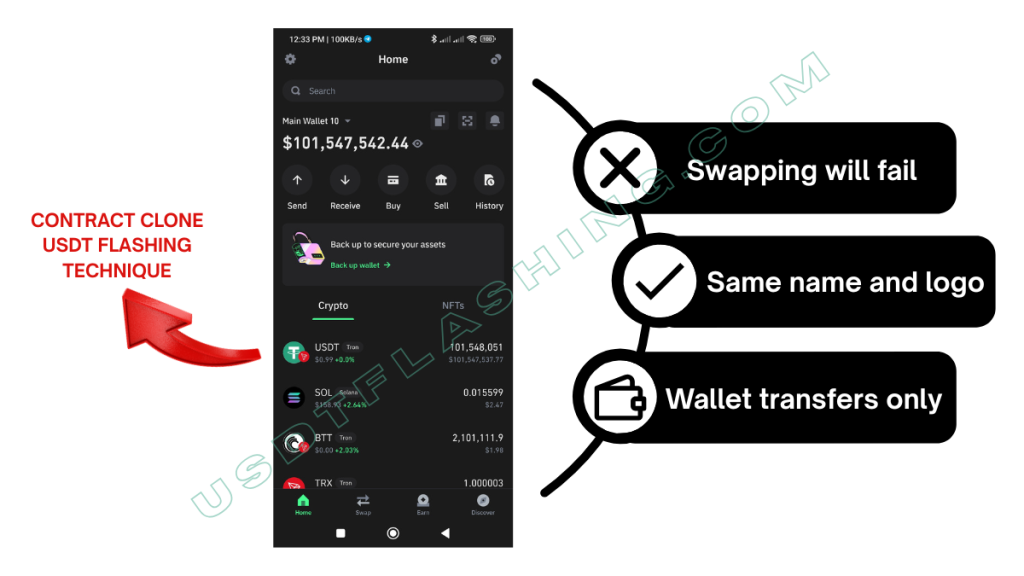
Contract Clone USDT Flashing Technique
This USDT flashing method creates a USDT flash variant that looks like Tether USD (USDT) at first glance but is flawed and missing important features of original USDT. While the first variant of this USDT flash type has the same name, it has a different contract address. In 2023, anonymous russian Solidity developers found a way to make the USDT flash token latch onto the original USDT contract address. This technique was adopted and enhanced by other developers and has since been perfected on the Solana, Tron, Ethereum and BNB Chains. However, the former type can still be found circulating the blockchains to date.
Pros:
- Automatic deposit confirmation (same contract address)
- Permanent validity/lifetime duration
- Full blockchain confirmation
Limitations:
- Wallet deposits only. Exchange Deposits will fail.
- Swapping will fail.
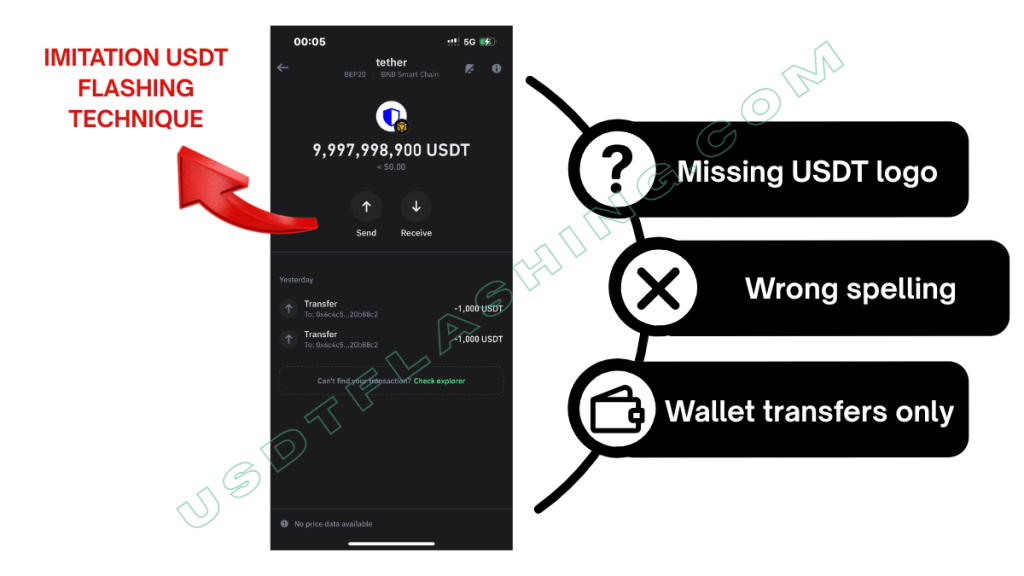
Imitation USDT Flashing Technique
In this USDT flashing method, a developer simply creates a solidity contract with seperate contract address but a logo that looks like the official USDT logo and a name that typed almost like Tether USD (USDT) e.g “tether” or “USDT.z” or “Teller USD“. The resulting token can then be infused with false liquidity which the other flash type lacks. This however, does not mean it can be sent to an exchange; the imitation flash type, like the contract clone USDT flash token type is also limited to wallets. Since this USDT flash token type has a different contract address than the original USDT tokens, most wallets require a manual importation, making it a more difficult to utilize than the contract clone USDT flash token.
Pros:
- Permanent validity/lifetime duration
- Full blockchain confirmation
- Liquidity often present – swaps may work
Limitations:
- Manual contract import
- Wallet deposit only – exchange deposit will fail
- Wrong name spelling and logo (e.g Tethered USD, USDT.z, Teller USD)
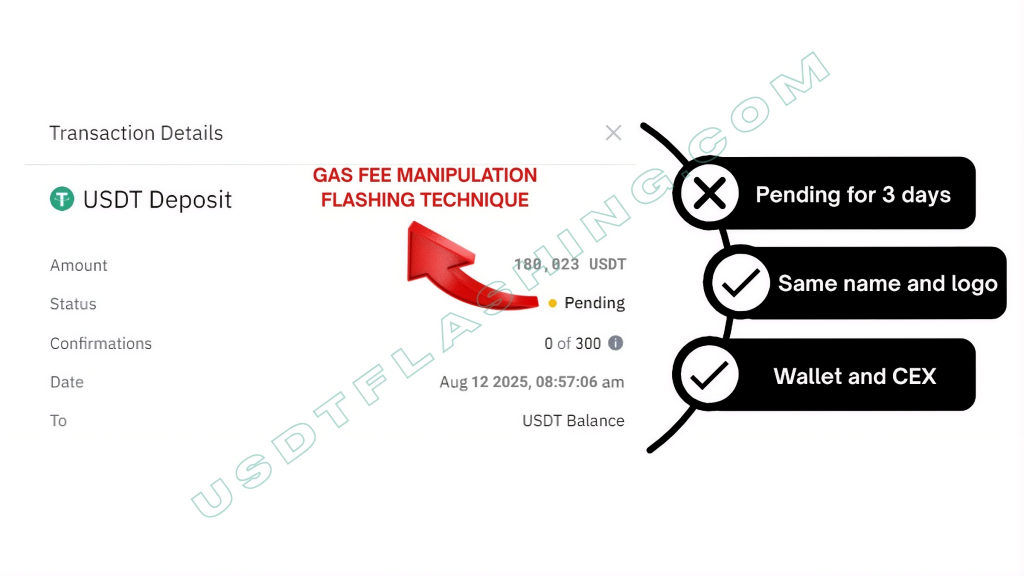
Gas Fee Manipulation Technique
For this method, a real USDT transaction is signed and sent as usual, but the transaction is manipulated programatically or in supported wallets to consume the lowest possible amount of gas (gwei). As a result, miners will fail to pick up the transaction and it will be dropped eventually, typically after three (3) days. For this USDT flashing technique to work, the sender must actually have the intended amount of USDT required for the flashing. This makes it simultaneously the simplest and hardest flashing type to execute. Unlike other flashing types, real USDT is involved in this method and the transaction can be sent to wallets, exchange platforms and websites. Blockchain confirmation will attempt to begin but will be stuck on pending before showing “failed” because the transaction will not be picked up. The USDT involved can not be swapped either.
Pros:
- Same contract address – no contract import required
- Can be sent to all receiver wallets, exchange platforms and websites
- Same name and logo
Limitations:
- USDT stuck – cannot be swapped or sent to another receiver
- Confirmation will never complete
- Transaction visible for only three (3) days before reversing
How to Spot Flashed USDT
Spotting flashed USDT can be tough. Check the transaction on a block explorer like Tronscan. If it shows “Pending confirmation,” the USDT isn’t really yours yet. This pending status means the transaction hasn’t been fully confirmed, and the USDT can still return to the sender wallet. If the USDT has been confirmed on the explorer, validate the contract address, name and logo. If the contract address of the USDT you received doesn’t match the official USDT contract address or has a different name spelling or logo, it is flashed USDT and not real USDT. You can see the contract address of the real USDT here.
Be careful and don’t trust just the initial appearance when dealing with USDT transactions. Check how many confirmations a transaction has to know if it’s real.
Uses of USDT Flashing
USDT flashing can be risky, but you can use it for legitimate purposes:
Testing Systems: Developers can use USDT flashing to test cryptocurrency wallets, exchanges, and other blockchain systems. They do this without risking real money. This way, they can make sure their systems handle transactions correctly.
Training and Education: Schools and training programs might use USDT flashing. They use it to teach students and new users about cryptocurrency transactions, so learners can understand transactions without the risk of losing money.
Temporary Transfers: Sometimes, people might use flashing to create temporary transaction records. This can prove they can send funds without making a permanent transaction. It can be useful when temporary proof of a transaction is needed.
Risks of USDT Flashing
USDT flashing has big risks:
Scams and Fraud: Scammers might use flashing to trick people. They make others think a real transaction happened, resulting in financial losses. The fake transaction can fool victims.
Misleading Transactions: Flashed transactions aren’t permanently recorded on the blockchain. They can trick recipients into thinking they’ve received funds, resulting in financial mistakes or losses. The recipient might act on the assumption that the funds are available.
USDT Flashing Software
There are many tools online that let people perform flashing transactions. We don’t recommend using them. However, you can check out Coin Flashr for research purposes. You can find it at getcoinflashr.com. There’s also a detailed article covering the best USDT flashing software here.
Conclusion
USDT flashing is a technique with both good uses and big risks. It can be useful for testing systems and learning. However, it also comes with dangers like scams and misleading transactions. People should be careful and aware of the risks, rather than acting on assumptions. Understanding both the benefits and the dangers of this practice is important. Staying vigilant helps avoid the risks associated with the practice.